Showing posts with label 1984. Show all posts

Thursday, May 9, 2013

My Original Utopia Revisited

"Now," the Devil said, reaching out for MJ's hand. "Let's think about that Utopia again. The one we talked about before. The one where you're the ruler of everything."

MJ shut her eyes and concentrated. The smell of Brimstone was fairly distracting, but not so much that MJ couldn't still see that world, the one she was so invested in before. She chewed on her bottom lip.

"Concentrate, MJ," the Devil said. He had a weird, raspy voice, so MJ imagined he was probably in his normal-face rather than the personas he'd been taking on all semester.

"I am concentrating," MJ said.

"We can make this happen if you really think about it. If you really focus."

MJ focused. But at the same time---would she really want this world, now? The more she thought about it, the less she really liked the idea of running a world. How would she be any better than Big Brother? Or Mustapha Mond? Or Sean Bean in the Island (which is a significantly different Sean Bean to the one in Game of Thrones who was way cool but wasn't on the show enough.)?

Would MJ really be able to run a good, solid utopia? Something worthy of Utopia-ness? Something that didn't turn quickly into a dystopia? Or a non-functioning utopia, like Rapture in BioShock?

"You know," MJ said, pulling her hands away from the Devil. "Maybe this isn't such a good idea. I've got some great leadership skills and I really like people, but I don't think I'd be the best ruler. We should stop this. Let's just let things be like they are."

The Devil didn't speak, but MJ had the feeling that the ceremony was over. Or something. Always hard to tell with the Devil. He did things very differently from everyone else.

"Don't open your eyes," the Devil instructed her. "If you look at me, you will die."

MJ sighed. "Yeah, okay, you got that line from Doctor Who. Loser."

Love and 1984

"So, tell me why you love 1984."

MJ wasn't entirely certain where the psychiatrist's chair had come from, or why the Devil had chosen to appear as Tony Stark this time around, but she wasn't one to shy away from discussing her favorite novel.

"It's one of the most tragic love stories of all time," MJ said. "Winston and Julia, torn apart because they literally can't be together in the world where they live."

"Interesting," Tony Stark said. MJ didn't like his tone. It was the tone the Devil used whenever he was getting ready to manipulate her. She hated that. Primarily, because the Devil was so damn good at it.

"I agree with MJ," her personal angel, who had taken the form of Steve Rogers, said. "It's a terribly raw, but realistic interpretation of love."

"As if an angel would know anything about love," Tony said.

"Better than you," Steve replied.

MJ had a feeling that the two of them were having some sort of a row that involved romance. She didn't approve. First of all, this was supposed to be about her, and before she knew it, tumblr would be just gifting the two of them.

"What makes you think it isn't love?" MJ interjected.

Tony coughed, and put on a pair of bright red reading glasses. He read from MJ's worn copy of the book.

"You notice, when O'Brien is talking to Winston and Julia about what they will go through in order to become part of the Brotherhood, Julia forcibly interjects, much like yourself in this situation?" Tony said. "Why didn't Winston feel as passionately? Why did she have to make certain that he loved her best?"

MJ's eyebrows knitted together. "Winston doesn't love her like she loves him," she said. "There's nothing wrong with that. It's a fundamental flaw in love."

"She's right, you know," Steve said. If MJ didn't know better, she'd think he was trying to be sassy. It was annoying.

"I'm certain she is," Tony replied. "But how can you love this book as some sort of quintessential love story, if the love story isn't perfect?"

"What about life is perfect?" MJ replied. "That's what makes the book phenomenal. The imperfections make it real."

Friday, May 3, 2013

What's LOOOOOOVE got to do, got to do with it Babe.

So I haven't posted about 1984 because this is kind of a rough text for me. This is my second time reading it and it does the same stomach upsetting that Frankenstein did for me. Which on an external level I can appreciate but on a deeper level makes me feel like a child.

You know how when you were a kid you would get mad. I mean like super mad because the world had wronged you so intensely that the only thing you could do was rage within yourself? And when your parents asked you what was wrong and you told them but they didn't understand and you wanted to shake meaning into them. This is the phenomenon of 1984 for me. I read that book and my hands shake and heat rises up behind my eyeballs making me tear up but not cry.

It is really freaking weird.

To start out with, I am not a huge fan for Winston as a character and I think that's why it works. I find myself repelled by Winston because he lacks the fire I usually associate with a protagonist. Winston is spineless but he needs to be in order to survive in this world. With eyes and ears everywhere there is that lack of the stand tall and proud and glare down your foe brass that I like to read. I want a protagonist that I can put my faith in and Winston is not really that character. That's where the gold is, he is the only character I am going to get out of this book. In this desolate, crap world the only kind of "hero" is Winston. I can't turn to the spunky side kick or funny cameo because every character is a sullied being that I don't want to associate myself with.

Winston works at a pointless job, In a shabby house, no friends, and is the only ray of damn sunshine you get in this story. When he feels emotion it is amplified by 1000 because his surroundings and even his past stories are devoid of any feeling. I had to stop reading at one point because he was admitting to Julia that he wanted to rape and then kill her and I as the reader, while disturbed, was secretly glad. I was so desperate for any semblance of emotion that his bestial response to Julia was taken as a positive even though it is as negative as you can get.

The fist to the gut of this book is the tension throughout. The false hope that its possible for Winston to win. For him to conquer Big Brother and live and be happy. The reader just wants there. To be a semblance that the lives in this book are worth something. The fact that the reader experiences this all on their own is cruel. The novel continually tells us that Winston knows he's going to get caught. He tells us this constantly, after sex,"alone" in his house , and lunch at work he just reminds himself. It might have just been this reader but I totally ignored Winston the first time I read this. I was totally thinking that something good could happen. Boy was I WRONG!

 We all know I'm a weepy person but this book makes me full out sob. I shake and my breath hitches and it is Ugly with a capital U. I cry this way because the breaking of a human "spirit" is literally the worst thing you can show me. The third part of this book shows me just how much spirit Winston had in the first two parts because they destroy it in the third. They break his body, they make him watch other human beings break, they shove his biggest fear in his face, and then they destroy Winston. They destroy his mind and every aspect of the character that the reader grew to know and they stretch that mother out.

 Asking one love his enemy, but not the Christiany sort of love, is sick. I think this is the bit of the over that I don't quite understand. I totally just read Raymond Carver's "What we talk about when we talk about love." And this form of love was not explained in the short story. I don't know how Winston's changed perspective of Big Brother. I think that it's just that you can't know what it's like to 'love' Big Brother until you do.


Wednesday, May 1, 2013

What Has Been Keeping MJ From Updating; Also: Isolation

So, that old saying "Bit off more than you can chew" really applies here, to my blog posting. I had made the awesome decision to do all of my blog posts in story format, and ended up slipping into a Socrates-like story where I'm saying all of the things I'd normally say only to somebody. Which, I guess, worked out for me. For, like, three posts.

I got freaked out about my little stories sounding bad, or becoming repetitive. In the end, I became that student, the one who needs to post something like ten blog posts before the end of the week or else her grade will be really poor.

So, we're doing a new thing. If I've got the story pre-written, I'm gonna post it as is. Otherwise, I'm going to take my big file of half-written blog posts and put them together in a standard format. And you will love it. I promise you.

So, let's talk Bioshock.

I'm playing Bioshock again for work on my last paper for this class. Among the things I'm discussing within the Utopian setting of Rapture is the isolation involved in Rapture's underwater world. For those of you who haven't played Bioshock, here's a trailer for the game.

Rapture is an isolated fallen Utopia (not a dystopia, per se, but a world that had been a Utopia at one point but had fallen to ruin.) The world was created in the mindset of Andrew Ryan (the narrator of the trailer), who wanted a Libertarian-esque world where no outside forces could come in and screw things up.

This sense of isolation is something I've noticed before in other works. In Herland, the female world is set aside from the rest of the population, the same with More's Utopia, and our recent viewing of The Island. Other Utopian stories we've discussed, such as 1984, Minority Report, Gattaca, and Brave New World have the whole world changed rather than just an isolated segment. For places like Twin Oaks in Virginia, isolation makes this system work, but I still see the "whole world change" as significantly more realistic. A slow, gradual change over the world can change everything just a little bit at a time, rather than isolating and completely altering everything at once.

What do you guys think?

Thursday, April 25, 2013

Under Constant Surveillance : 1984 and Beyond


   If I was Winston, and had to experience what he experienced through the watchful eyes of Big Brother, or in modern times the United States government, I myself most likely would be considered rebellious, simply for the fact that I have my own mind, and I refuse to have it oppressed by oppressive forces. After seeing how Big Brother’s control had to some degree dimed Winston’s will for individualism, it is clear to me that surveillance can be another powerful form of oppression.  


Not ever being at peace with one’s thoughts for fear of having those thoughts used against you would surely be terrifying. Let consider the following. Imagine how many times you have had a thought, or notion about someone, or something that was better kept to yourself, now imaging those same thoughts being watched over by someone, or something that you have no knowledge of. Would you even want to have the capability of thought anymore? Privacy should be granted to everyone as a human right. Constant surveillance for every single action that a person does, or thinks, I feel would drive a person mad.


While it is true that much of our lives are being watched over through various sources such as; cameras, the internet, and other people, I still feel that ones thoughts, especially the kind that are better unsaid should be granted as a protected right for everyone to keep private if they so choose.   

Sunday, April 21, 2013

Down With 1984! Down with 1984! Down with 1984!

To be honest, I ended up finishing 1984 but I got through enough of it that I felt like I dint need to read to the end and let me tell you why. It was so monotonous! After reading page after page of how Winston secretly hates the party and how Julia hates the party and what they do to undermine the party I was on the verge of exploding because at that point I was just like then do something already!!!! It’s no use undermining the party where no one can see them because that really isn’t changing anything. If they really want to make a change they should publicly do something to go against the party. Yeah they would probably be vaporized but at least you were brave enough to do something about it and who knows maybe other people would be brave enough to follow their example in the future and if you got enough people to do something that went against the party publicly then maybe change can actually be made.  I have to say that I was rooting for Julia and Winston when they finally found out that the brotherhood existed but I instantly began to think of the brotherhood as doing the same thing, an underground operation that was almost too afraid to do anything. Now as I have said I didn’t get a change to finish the book so I don’t know if Winston or Julia actually were able to do something with the brotherhood in order to bring about change to this war driven nation but from what I was getting from reading other people’s posts the ending didn’t seem as if there was a big change or a different outcome in this society. This book just screamed rebellion and if Winston, Julia and the brotherhood were not able to make a change in Oceania then there would eventually be a change because how long could a society remain like this especially when people like Winston seem to be fully aware of how they are being controlled.

Saturday, April 20, 2013

1984


George Orwell’s 1984 is an interesting book to say the least. Do I personally like the dystopian society of the future or the warning it contains? No, not really, since it has given rise to extremism in some people who are constantly the look out saying, “Big brother is watching us,” and that we need to do more to protect our privacy. Yet these same people do relatively nothing about stopping “big brother.” If there is one positive thing I have taken from this book it is that if you really want to buck the system simply do as Julia did and buck it in a small, personal way.
 

            There will always be government, and if history has taught us anything it is that when government becomes too powerful it will eventually be overthrown. Examples to support this lesson are the French Monarchy, the Soviet Union, and the Roman Empire, all of which have fallen due either to government becoming too corrupt or too powerful. Even the corruptness of Aztec rule led conquered peoples to align themselves with the Cortes and the conquistadores to bring about the fall of Montezuma. Following Burke, many historians caution that “those who do not know history are condemned to repeat it.” Well, it seems clear to me that it is instructive to point out that governments fall from time to time, and in line with that pattern we need not worry about a government becoming to powerful. Eventually, like the bloated governments of history, it too will fall.

            Another element that induces fear in 1984 is when Winston begins to accept O’Brien’s version of events. This transformation sets a lot of people off, but to my way of thinking we already accept most things in our life axiomatically. For instance why is the color blue called blue? Why is this the symbol for the number 5 a 5 and not @? The idea that people can manipulate another into thinking a certain way is not a new concept. Hell, it’s been happening through the education system since most of us were in kindergarten. Further, a good defense lawyer such as –let’s say Johnny Cochran, can even trick people into seeing an obvious truth as a lie. And as far as the controlling of history goes it is a demonstrable fact that anytime there is a war the victors get to write the history, not the defeated. Also history is rewritten every time there is new information discovered or, as the saying goes, “Each generation writes its own history of the past.”
 

               My closing thoughts about this book are a cautionary tale that if you spend all your time worrying about big brother watching you then you miss out on life. Were only here for so long so kick back relax and enjoy it. Also embrace new teachings, just because your think a certain way does not always make it right and sometimes in life 2+2 does equal 5. 

Friday, April 19, 2013

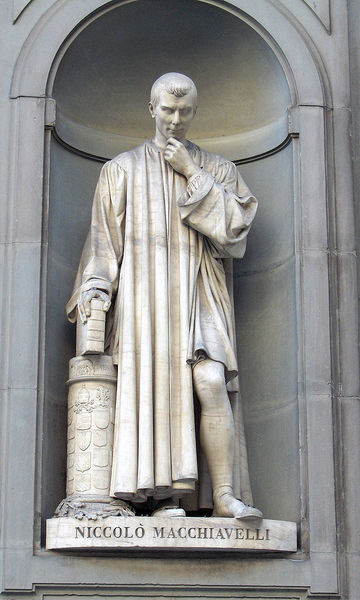
Machiavelli and 1984

After reading 1984 again I was struck by how similar many of the ways of control were similar to that recommend by Machiavelli. 

Now before the sarcastic responses come out about how this is obvious, after all Machiavelli liked tyrants, blah blah blah. 
NO this is actually somewhat surprising. While Machiavelli is somewhat infamous for his discussions of how a person should rule as a monarchy in his book The Prince he was diametrically opposed to tyrants. Even if you ignore his writings from his Discourses on Livy he did not support the uncontrolled use of power by an individual. And many of the advice he gives to monarchs on how to rule seems to be followed by the Party in 1984.

1. A Ruler should be feared but not hated: 
This was one of the most important aspects of ruling for Machiavelli was that the citizens should fear the ruler but not hated him. For Machiavelli he was adamant that the worse thing a ruler could be was hated. He should aspire to be feared and loved but must avoid at all costs being hated. So Machiavelli argues that a leader must at least appear to be moral, or act immoral in ways that will not bring hate to him.

And the Party exemplifies this. It fits all 3 parts of Machiavelli's advice. The Part makes itself both feared and loved by its members. (Fearing being arrested for thought crime and loving Big Brother for the protection he provides for them). Even the skeptical Winston, before being broke, expresses at times his love of Big Brother (like during the Hate) and his fear of him is always constant. 
And the hatred that the members of the party have is directed towards outsides forces, (Goldstein, the country they're at war with) instead of towards the Party.

2.  Another aspect Machiavelli argued is to avoid interfering with the common people as much as possible. If you need to do change he argues do it quickly and get it done with. And both of these aspects are again shown in 1984. The Party avoids interfering with the Proles as much as possible. They let them work but unlike how they treat the members of the Party they do not have the boot constantly at the neck of the Proles.(Or at least they do not seem to)  I think this is an important aspect of it because if they were to constantly and obviously oppress the Proles eventually the Proles would get fed up with it and might push back. But by not obviously oppressing them, and keeping them fed and entertained the Proles will be unlikely to ever rebel. 

3. Another aspect that reminds me of Machiavelli is part of his encouragement not to be hated. One part of it is it prevents people from being able to plot against you. Because if you try to convince another person to help you rebel and assassinate the leader that person has every reason to betray you. By doing so they will be rewarded and even if they do not they have every chance of not succeeding. And if you are not hated even if you succeed in your assassination attempt you will still be hated by the common people. So only a person who absolutely despises the ruler would agree to plot against the ruler. And this is remarkably similar to how the Party works except in this case the crime would not be plotting to overthrow the Party or assassinate Big Brother but simply not liking the Party.

While some aspects might not quite work with Machiavelli (and in the end he would not approve of the Party in 1984) I suspect that Orwell may have been influenced by Machiavelli.

Tuesday, April 16, 2013

Is an Utopia a Reality?

      George Orwell's Nineteen Eighty-Four is possibly my favorite piece of dystopian literature. Sure, the regime lacks the seemingly well-placed love and cleverness of the one in Aldous Huxley's Brave New World, but I think that's why I enjoy Oceania's governmental system. These people aren't in it to create a better world or help the people who need it; they're in it for the power, plain and simple.
      But, I've always enjoyed reading about villains who are power-hungry and evil simply for the sake of being evil.

      I also really liked reading the philosophical debate at the end of this book. I've always kind of enjoyed philosophy, so this kind of battle of wits excites me.

Here is my favorite quote from this book: “ 'We control matter because we control the mind. Reality is inside the skull' ” (274).

      In a way, O'Brien, the speaker here, is wrong; however, in a way he's right. Someone once asked me how many realities there are. I immediately just wanted to say “one,” but once I thought about it I realized the answer is sort of “infinitely many.” (Actually, they're not infinite, but the number is so high they may as well be infinite.)

 It's not quite as fancy as a "multiple earths" theory.

     Now, stay with me here as I describe my wonky theory. There is one reality in which all things actually happen as they are. This reality is called “Truth.” All of our perceptions and personal takes on “Truth” are the other numerous realities. (I call them “the Infinities.”) Here's an example:

I'm sitting in the dining hall at a table by myself. At the table next to me is a group of three people chatting. Now, in the prime, true reality (“Truth”), they're making fun of my haircut; however, I think (from what little I eavesdrop) that they're talking about basketball. My perception is one of the “Infinities.” While my thoughts aren't true to what actually happens, they're true to me, and therefore realistic. So, in consequence, there are infinitely many realities based upon our daily perceptions.

Get it?

"Welcome to Coblentz Dining Hall: where the recipes don't make sense and your perception of reality doesn't matter."

      So, with so many realities, is it even possible to have an utopia? Sure, one may exist in “Truth,” but what if everyone perceives it differently? It may be perfect, but it won't be utopian to some people because it won't line up with their expectations and perceptions of perfection. If they don't want to go along with it, how can the society be perfect/better? How, then, can it be utopian?

(Multiple earths picture taken from 123rf.com. Image of Coblentz taken from youvisit.com.)

Sunday, April 14, 2013

Historical Destruction - Rupturing from the Past


My previous blog post was about our utopian novels’ ideas of the future. Now let’s talk about the past!

One of the more striking comparisons between Brave New World and Nineteen Eighty-Four is both worlds’ abhorrence towards history.

In Brave New World, the world is completely ignorant of all things historical. “History is bunk,” says Mustapha Mond, quoting an actual saying from the real-life Henry Ford (Brave New World, 40).

The following is one of my favorite passages from Huxley’s novel, due to its bluntness, take-no-prisoners approach, and its excellent summary of Brave New World’s historiography:

Mond “waved his hand, and it was as though, with an invisible feather wisk, he had brushed away a little dust, and the dust was Harappa, was Ur of the Chaldees; some spider-webs, and they were Thebes and Babylon and Cnossos and Mycenae. Whisk. Whisk – and where was Odysseus, where was Job, where were Jupiter and Gotama and Jesus? Whisk – and those specks of antique dirt called Athens and Rome. Jerusalem and the Middle Kingdom – all were gone. Whisk – the place where Italy had been war empty. Whisk, the cathedrals; whisk, whisk. King Lear and the Thoughts of Pascal. Whisk, Passion; whisk, Requiem; whisk, Symphony…” (Brave New World 41).

The way the narrator shrugs away all major movements, empires, and people that shaped the entire world is chilling. Huxley’s universe would think the same for all things history. Not only does it not matter, it is absolutely repugnant.

Orwell’s Nineteen Eight-Four is no better, despite a different approach.

As you know, Oceania’s view of history is to completely revise it. To take one example (you can find many, many more within the entire book), political international alliances were altered to reflect the current treaties: “The Party said that Oceania had never been in alliance with Eurasia. He, Winston Smith, knew that Oceania had been in alliance with Eurasia as short a time as four years ago” (Nineteen Eighty-Four 35).

So why does history frighten them?  Why would one want to irreparably rupture from the past?

Orwell’s work is easier to figure out, since it explicitly tells us. The Party’s slogan (“Who controls the past controls the future: who controls the present controls the past” (Nineteen Eighty-Four 35-36)). It is purely about control of the populous, brain washing for perpetual political gain.

For Brave New World, it can essentially be summarized as the following: suppressing history can control intellectual freedom. By learning historical events, one will realize how life was like in the past. Even if they see the past as horrible compared to the “utopian” World State, one still learning something they shouldn’t. What will simply be a look at a history book will become an obsession of the past, which will eventually lead to intellectual independence.

yahoo.com
 This is an actual response on Yahoo! Answers 
to the question "Why is history not important?"

As a medieval historian, I am absolutely horrified by people’s dismissal of this time period. I’m sure Dr. Mitchell-Buck will agree with me here, that medieval history is not the most important area of interest in the field of study (and that multiple misconceptions about the era still exist today). And I’m also more than certain that Sam will agree that history (in general) is much more than just learning facts and dates about dead people.

How much of our culture do we owe to medieval history? Answer: a whole lot. For example, did you know that the university system was designed during the medieval period, following cathedral schools (which themselves followed monastic communities)? That’s right – thank those “old” medieval intellectuals for giving us a solid education!

Okay…impromptu rant over. Needless to say, I could easily go on. History is essential to society; forget the whole adage “those who forget history are doomed to repeat it.” It’s more than that: it is society’s identity. What would the world be like if it weren’t for certain movements in history? Why would we possibly wish to demonize or revise it? If we do such things, then our identity in society is substantially lost.

This is what terrifies me the most about these two works: they lose their identity; instead of being on a continuum, they are forever isolated in time.

Friday, April 12, 2013

Two Thousand Thirteen


We live in a very different society to the one portrayed by Orwell through the character of Winston in Nineteen Eighty-Four as the United States prides itself as a country on promoting the idea of freedom. To me, this means the freedom to express our humanity through how we choose to live out our lives. However, these freedoms should never be taken for granted and need to be carefully guarded. We need to be aware of groups that demand conformity, be aware of attempts by groups to control language, and be aware of grabs for power as these are the key weapons in the arsenal of the Party.

The character of Winston loses his humanity to the Party in the novel. Throughout the first two sections of the novel, he tries to hide his humanity by attempting to conceal his personal relationship with Julia and writing his private thoughts in a diary. He even tries to join a secret Brotherhood that works against the party in a clandestine manner. However, in the end, the inexorable, all-powerful Party owns him and he is no longer free to even think about defining himself through relationships, preferences, and passions (Orwell). This matters in our society because many believe we should be free to define ourselves through our relationships, preferences, and passions, as long as we are not hurting anyone else.

Although our society is not at all similar to the one portrayed by Orwell, we are not always free to define ourselves through our relationships. A group that has made this difficult is, in this case, the federal government. The Defense of Marriage Act of 1996 defines marriage as a union between a man and a woman for the purposes of federal benefits (Liptak). This act rewards heterosexual marriage but disadvantages those who do not share that orientation, devalues their relationships, and provides an example of one group attempting to have another group conform to an arbitrary norm.

In our society, we also need to be aware of how groups attempt to control language. A current example is the debate on gun rights. The language used by the NRA includes words and phrases such as “Ring of Freedom,” “freedom fight,” “right,” “firearm,” and “King Pinocchio” (referring to the President) (NRA). The NRA appears to avoid words used on the other side of the debate by the White House, such as “gun violence,” “wrong hands,” “background check,” and “mental health” (The White House). As Orwell makes clear in his ideas on newspeak in Nineteen Eighty-Four, if a group can control the language used, it can control the message and ideas about an issue, as each of these groups are trying to.

We also need to be aware of grabs for power. In recent history, one of the most incredible grabs for power in the United States must be the Uniting and Strengthening America by Providing Appropriate Tools Required to Intercept and Obstruct Terrorism Act of 2001 (USA PATRIOT Act), of which an extension was signed in 2004. This post 9/11 legislation broadened the discretion of law enforcement in detaining and deporting immigrants suspected of terrorism-related acts indefinitely, significantly reduces restriction in law enforcement agencies gathering of data, regulation of financial transactions, particularly those involving foreign individuals, and expanded the definition of terrorism to include domestic terrorism. The extension in 2004 includes roving wiretaps, searches of business records (including library records), and conducting surveillance of “lone wolves” (107th Congress; “Patriot Act”). The USA PATRIOT Act gives the federal law enforcement powers to observe citizens and immigrants alike without permission from the courts in many instances.


Orwell’s novel contains these warnings for humanity but I go to bed every night safe in the knowledge that members of U.S. society would never put up with any serious imposition on their freedoms. They would never let apathy and taking freedoms for granted to allow any one group to hoodwink them into the kind of slavish devotion to it that Winston experienced. Right?

Works cited:

107th Congress Public Law 56. Uniting and Strengthening America by Providing Appropriate Tools                Required to Intercept and Obstruct Terrorism (USA PATRIOT Act) Act of 2001. Washington: GPO,      2001. Web. 12 April, 2013.

Liptak, Adam. “A Look at Issues in the Defense of Marriage Act Case.” New York Times, 27 March 2013.Web. 12 April, 2013.

NRA Digital Network. National Rifle Association of America, 2013. Web. 12 April, 2013.

Orwell, George. Nineteen Eighty-Four: A Novel. Orlando: Harcourt Brace, 1949. Print.

“Patriot Act.” Wikipedia. Wikimedia Foundation, Inc., 8 April 2013. Web. 12 April, 2013.

The White House. The White House, n.d. Web. 12 April, 2013. 

Picture credits:
qeisecurity.com
fixthispcnow.webs.com

Thursday, April 11, 2013

DoublePlusLike Thy Enemy

I have just finished reading 1984 for the second time and I am so glad I revisited this novel. In the final book, I had an eerie recollection of a part in Night by Elie Wiesel. In MiniLuv, or the Ministry of Love, when Winston was told to strip down to his birthday suit and stand in front of a three-way mirror, all I could picture in my head was Elie Wiesel's experience of seeing his reflection for the first time since he entered the Nazi concentration camps. 

Winston had been so diminished, physically and mentally, and almost nothing remained of his former self. He did not look like Old Winston and, although he called himself a man, he had the bodily dimensions of a pre-teen. 

Being at such a deprived state, Winston was empty, just as O'Brien wanted. That way, Winston could be filled up and satiated with Big Brother. Once he surrendered the last thing that mattered to him, Julia, he Big Brother was able to take care of him as he should: feeding him three meals a day, letting him smoke decent cigarettes and allowing him personal hygiene. Winston could only come to love Big Brother.

What we have here, my friends, is a classic case of Stockholm Syndrome. It just disgusts me the mental torture and manipulation that humans are capable of. How scary the thought is that someday, the government may in fact have a way to find out our deepest, darkest fears and use them against us? I cannot even draw to mind what my biggest fear is, and I get creeped out just wondering what it might be and knowing my fear would be greater when it was presented to me. 

I really hate cotton balls, but I hardly doubt they'd be a torture tactic. 

A curious thought just popped into my head: Winston hates rats, and Julia turned him in, or ratted him out, so it's interesting that he claimed to have loved her. Is one of the morals that Big Brother is trying to get across that what you love the most will be your downfall? Hmm....

Also, Julia confessed to having betrayed Winston, I get that much. But how did she end up betraying him? What did she scream and beg for them to torture Winston with and not her? 

Damn you, George Orwell for leaving me with all these questions! 


The Future is Here...


There’s no question that every detail of George Orwell’s work has some significance. We can attest to his intelligence and social commentary in his other famous work, Animal Farm. This especially holds true for the time that Nineteen Eighty-Four takes place. I believe we briefly touched upon this in class, but I would like to analyze why he chose this specific date.

All of our other utopian works that involved the future (which excludes Thomas More’s Utopia, Unveiling a Parallel by Alice Ilgenfritz Jones and Ella Merchant, and Charlotte Perkins Gilman’s Herland) have placed them far into the future, at least a century. The main narrative in Edward Bellamy’s Looking Backward and William Morris’s News from Nowhere both took place over a century after they were written (1887 and 1890, respectively). Brave New World by Aldous Huxley takes place over six hundred years in the future (in the year 2540 AD; corresponding to 632 years after first Model T Ford). They all take place after the current generation was long dead.  

Nineteen Eighty-Four, on the other hand, takes place a mere 35 years after it was published. He could have easily placed the novel in the year 2000, or 2500, or even 3000, and it would still make sense. The idea of totalitarianism and complete oppression can fit in any period of humanity.

http://whsmassmedia.com

However, Orwell purposely decided to place his work less than forty years in the future. Those who read his work would be alive during the titular time period. To me, that places a sense of urgency and a sense of imminence.

Whether or not Orwell was talking about the Soviet Union, he obviously saw an impending fear in totalitarianism. The horrors of Nazi Germany were unveiling constantly by this point, since it was only four years after the end of the Second World War. He had experienced the rise of fascism in the Spanish Civil War. The political and military rise of the Soviet Union after World War II, matching in strength of the United States, may have well been a factor in his dating.

So, why did Orwell place his novel so near in the future? He had experienced the rise of totalitarianism – is this a reaction, a what-if scenario, if the fascists and Nazis won the War? Or is it a warning for the present (assuming that his intent was such) about the future? If so, did this

I would also like to hear your thoughts on this as well! Of course, there is not a single right answer here. It’s impossible to truly judge an author’s intent. But let’s see where this discussion heads…

Wednesday, April 10, 2013

Finally a book I don't hate.... Surprisingly.

Okay, I'm going to say it. I'm actually enjoying 1984 both as a work of fiction and as a very real portrait of concerns for the future.

I didn't like the other dystopia we read primarily because I did not care for the premise fear. The fear of technology is rather repugnant to me, but i have already waxed on about that more than enough.


1984 presents a legitimate fear of mine and I believe of many people with regards to the future.It recognizes   that people.... Well, we kind of suck, don't we? We hate each other and start wars over petty things. You cant turn on the news without hearing  about a shooting, murder, kidnapping or military tragedy. Utopia doesn't exist because we aren't good enough to make it, not even close.

This novel describes a possible scenario, in which an incredibly evil, or at best a terribly misguided but deeply charismatic group of people convince others to submit to unspeakable things in the name of creating a better world. Now this is something that could actually happen and a real fear.

We've seen horror stories about cult leaders like this, haven't we? Passionate and charming,  they convince their followers of horrendous things and tell them they are happy, and they believe it. What if this happens on a massive scale? Couldn't it.... Hasn't it already dozens if not hundreds of times....Hitler of course comes to mind but haven't we been doing this as far back as recorded history can remember?  People who slaughtered others in the name of ending suffering and bringing about a new world.


This is the phrase that chills me to the bone:


A war to end all wars.

Monday, April 8, 2013

2+2=5

Wow. Mind boggling. Terrifying.

Those are the three main thoughts running through my head after finishing Book I of 1984. We had a discussion about similar things once in AP U.S. History in high school. We discussed how many people just accept what they hear without questioning what is being said, and how this makes us as a society rather gullible. This gullibility can be seen in the citizens of Oceania.

During that class period we also discussed how easy it could be for people to alter history and how history is written by the “winners”. (Such as with WWII and the camps in Europe AND the US) In Oceania there is the Ministry of Truth, which alters history to match the Party’s version or vision of past events. A Ministry of Peace, which wages war because fighting comes before peace – or so we are told. The Ministry of Plenty, which plans economic shortages but tells everyone that we are doing great. And finally there is the Ministry of Love, which I assume is where all the corrupt ideas and actions of the government are kept hidden. All of these ministries are frightening and can be seen in society today. Oceania's slogan: “WAR IS PEACE; FREEDOM IS SLAVERY; IGNORANCE IS STRENGTH” kind matches along what happens in the U.S. We go to war to “make” peace. We “free” countries by enslaving them. And the people that are ignorant of corruption, as the proles supposedly are, are relatively happy. ← Ignorance is bliss, right? 


The people of this society are so controlled, so brainwashed that they cannot even have private thoughts. I should rephrase that, private thought that are anti-government. If I feared being caught and imprisoned every time I had a thought that was against the current political leaders, I would live in constant fear of being caught. They can't even have their own, individual private thoughts. They will be told on by their young spies. The kids are raised to tell on people that are doing “wrong”. I remember being raised to not be a tattle-tale (which is what these spies are). It was looked down upon.

I don't know, this is by far the worst “utopia” we have read. I could have lived and been satisfied in the World State, but Oceania is too corrupt for me. I think our own politics are corrupt to the point that I think we should just do away with political parties or political associations. And Oceania seem twenty-thousand times worst. 

Image 1: http://www.thesun.co.uk/sol/homepage/news/754538/Why-Britain-is-Great-Pub-Landlord-Al-Murray-Ignore-lecturers.html
Image 2: http://kairisoosaar.wordpress.com/2010/02/01/pr-and-propaganda/
Image 3: http://tigersoftware.com/TigerBlogs/June-13-2008/index.html