Showing posts with label Scott. Show all posts

Sunday, April 14, 2013

Historical Destruction - Rupturing from the Past


My previous blog post was about our utopian novels’ ideas of the future. Now let’s talk about the past!

One of the more striking comparisons between Brave New World and Nineteen Eighty-Four is both worlds’ abhorrence towards history.

In Brave New World, the world is completely ignorant of all things historical. “History is bunk,” says Mustapha Mond, quoting an actual saying from the real-life Henry Ford (Brave New World, 40).

The following is one of my favorite passages from Huxley’s novel, due to its bluntness, take-no-prisoners approach, and its excellent summary of Brave New World’s historiography:

Mond “waved his hand, and it was as though, with an invisible feather wisk, he had brushed away a little dust, and the dust was Harappa, was Ur of the Chaldees; some spider-webs, and they were Thebes and Babylon and Cnossos and Mycenae. Whisk. Whisk – and where was Odysseus, where was Job, where were Jupiter and Gotama and Jesus? Whisk – and those specks of antique dirt called Athens and Rome. Jerusalem and the Middle Kingdom – all were gone. Whisk – the place where Italy had been war empty. Whisk, the cathedrals; whisk, whisk. King Lear and the Thoughts of Pascal. Whisk, Passion; whisk, Requiem; whisk, Symphony…” (Brave New World 41).

The way the narrator shrugs away all major movements, empires, and people that shaped the entire world is chilling. Huxley’s universe would think the same for all things history. Not only does it not matter, it is absolutely repugnant.

Orwell’s Nineteen Eight-Four is no better, despite a different approach.

As you know, Oceania’s view of history is to completely revise it. To take one example (you can find many, many more within the entire book), political international alliances were altered to reflect the current treaties: “The Party said that Oceania had never been in alliance with Eurasia. He, Winston Smith, knew that Oceania had been in alliance with Eurasia as short a time as four years ago” (Nineteen Eighty-Four 35).

So why does history frighten them?  Why would one want to irreparably rupture from the past?

Orwell’s work is easier to figure out, since it explicitly tells us. The Party’s slogan (“Who controls the past controls the future: who controls the present controls the past” (Nineteen Eighty-Four 35-36)). It is purely about control of the populous, brain washing for perpetual political gain.

For Brave New World, it can essentially be summarized as the following: suppressing history can control intellectual freedom. By learning historical events, one will realize how life was like in the past. Even if they see the past as horrible compared to the “utopian” World State, one still learning something they shouldn’t. What will simply be a look at a history book will become an obsession of the past, which will eventually lead to intellectual independence.

yahoo.com
 This is an actual response on Yahoo! Answers 
to the question "Why is history not important?"

As a medieval historian, I am absolutely horrified by people’s dismissal of this time period. I’m sure Dr. Mitchell-Buck will agree with me here, that medieval history is not the most important area of interest in the field of study (and that multiple misconceptions about the era still exist today). And I’m also more than certain that Sam will agree that history (in general) is much more than just learning facts and dates about dead people.

How much of our culture do we owe to medieval history? Answer: a whole lot. For example, did you know that the university system was designed during the medieval period, following cathedral schools (which themselves followed monastic communities)? That’s right – thank those “old” medieval intellectuals for giving us a solid education!

Okay…impromptu rant over. Needless to say, I could easily go on. History is essential to society; forget the whole adage “those who forget history are doomed to repeat it.” It’s more than that: it is society’s identity. What would the world be like if it weren’t for certain movements in history? Why would we possibly wish to demonize or revise it? If we do such things, then our identity in society is substantially lost.

This is what terrifies me the most about these two works: they lose their identity; instead of being on a continuum, they are forever isolated in time.

Thursday, April 11, 2013

The Future is Here...


There’s no question that every detail of George Orwell’s work has some significance. We can attest to his intelligence and social commentary in his other famous work, Animal Farm. This especially holds true for the time that Nineteen Eighty-Four takes place. I believe we briefly touched upon this in class, but I would like to analyze why he chose this specific date.

All of our other utopian works that involved the future (which excludes Thomas More’s Utopia, Unveiling a Parallel by Alice Ilgenfritz Jones and Ella Merchant, and Charlotte Perkins Gilman’s Herland) have placed them far into the future, at least a century. The main narrative in Edward Bellamy’s Looking Backward and William Morris’s News from Nowhere both took place over a century after they were written (1887 and 1890, respectively). Brave New World by Aldous Huxley takes place over six hundred years in the future (in the year 2540 AD; corresponding to 632 years after first Model T Ford). They all take place after the current generation was long dead.  

Nineteen Eighty-Four, on the other hand, takes place a mere 35 years after it was published. He could have easily placed the novel in the year 2000, or 2500, or even 3000, and it would still make sense. The idea of totalitarianism and complete oppression can fit in any period of humanity.

http://whsmassmedia.com

However, Orwell purposely decided to place his work less than forty years in the future. Those who read his work would be alive during the titular time period. To me, that places a sense of urgency and a sense of imminence.

Whether or not Orwell was talking about the Soviet Union, he obviously saw an impending fear in totalitarianism. The horrors of Nazi Germany were unveiling constantly by this point, since it was only four years after the end of the Second World War. He had experienced the rise of fascism in the Spanish Civil War. The political and military rise of the Soviet Union after World War II, matching in strength of the United States, may have well been a factor in his dating.

So, why did Orwell place his novel so near in the future? He had experienced the rise of totalitarianism – is this a reaction, a what-if scenario, if the fascists and Nazis won the War? Or is it a warning for the present (assuming that his intent was such) about the future? If so, did this

I would also like to hear your thoughts on this as well! Of course, there is not a single right answer here. It’s impossible to truly judge an author’s intent. But let’s see where this discussion heads…

Monday, March 25, 2013

Learning about the Utopian worlds


An idea has been developing in my head. Specifically, I was trying to answer this question: how is the technique of storytelling in Brave New World different from the other works we’ve read?  I was hoping to talk about this during class, but lo and behold there was snow! So I said to myself, why not kill two birds with one stone, and write a blog post about it? Here we go:

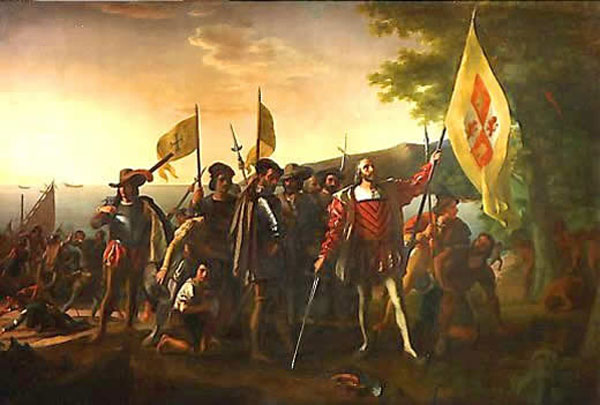
Christopher Columbus, from oceanexplorer.noaa.gov
All of the previous literary utopias (from Thomas More’s Utopia onward) have been told from an outsider. More had Raphael Hythloday, a world traveler, describe the titular island; Unveiling a Parallel by Alice Ilgenfritz Jones and Ella Merchant told their story through an unnamed man who travelled to Mars on an “aeroplane”; Edward Bellamy’s Looking Backward and William Morris’s News from Nowhere both had “deep-sleep” narrators, who both left their own world to wake up in the future; Charlotte Perkins Gilman’s Herland had a similar device to More’s narrative, in that three men physically travelled to an unknown location.

All of these narrators lived their own lifestyle in their own world before travelling to these utopian locations. They all are easily able to compare and contrast these new people and cultures to their own. In many cases, we learn about the utopian culture by the narrator simply asking questions to the natives.  

"Brave New World;" wikipedia.org
 
However, in Aldous Huxley’s Brave New World, we don’t have that leisure. Our main characters, Lenina Crowne and Bernard Marx, live in this society and know the culture and daily life of the World State just like we would know our own. There’s no real need for these characters to ask questions.

So, how does Huxley try to explain this new world without spoon-feeding it to us? How can he help us explain the intricate reproductive details of the Central London Hatchery and Conditioning Centre without breaking the fourth wall?

The novel opens up with students taking a tour of the facilities. The Director of Hatcheries and Conditioning, along with employee Henry Foster, gives realistically simplified explanations about the technology and ethics of this world, including the highest record of siblings from a single ovary (pg 19) to the so-called “Bokanovsky’s Process” (17-18). We, the reader, even learn about what the children don’t know – such as what a “parent” is (32). In this way, the reader can study, through the children’s questions and answers and the Director’s explanations, how this world of Huxley differentiates from our own.

Personally, I think Huxley was a genius in this way. Where all of our other readings had an outsider to explain the differences of cultures, he uses a realistic medium (young students) to explain to us, the reader, what this world is like. We learn about the World State by people within the culture, not outside it; this adds a whole new depth to the novel that we had not seen before.

Friday, February 22, 2013

Raphael Hythloday: Unreliable Narrator for Greater Understanding?


The entire description and interpretation of the island Utopia rests solely on Raphael Hythloday, an experienced sailor who traveled with experienced explorer Amerigo Vespucci on multiple occasions. He is the first (perhaps unwittingly) to circumnavigate the globe, and a sailor who learns from traveling like Ulysses and travels to learn like Plato (10-11). This is certainly all very impressive, and extremely admirable. Certainly, More couldn’t be so lucky to have the Raphael Hythloday tell him about the Utopian island.

That is, until we realize the meaning of his name.

As we learned, his surname Hythloday literally means “nonsense-distributer” or “nonsense-peddler” (7). This, I theorize, tells us all what the Utopian description really is: nonsense. It is awfully convenient that, as Peter Giles admits, “there is no mortal alive today [who] can tell you so much about unknown people and lands” (10). Now, I am not saying (although possible) that Hythloday is fabricating his entire story (for example, he never traveled with Vespucci) but that the specific details of false.

This would certainly explain some rather contradictory and inconceivable notions of the island Utopia to real-life Sir Thomas More. For instance, the fact that lawyers “are excluded entirely” (75) strikes me as extremely odd for More’s vision. More, after all, eventually became the highest and most powerful lawyer in all of England.

Wikipedia.org; "Thomas More"
 “I hate my job.”

Another example involves the unheard of tolerance of religion (except for atheism, which is opening a whole other can of worms). Real-life Thomas More, as Lord Chancellor of England, prosecuted English Protestants under King Henry VIII. Later, in the 1530s, when Henry broke away from the Catholic Church and required all English citizens to recognize the king as Supreme Head of the English Church, More refused, stating that his Catholic faith could not recognize the king as a sort of “new pope.” As a result, More was sentenced to death and was beheaded in 1535.

Here’s the real kicker: the reason that there was religious intolerance in much of human history is the exact same reason that Hythloday says there is religious tolerance in the island Utopia. When a fellow Utopian ignored the law and continued to preach against others, “he was tried on a charge, not of despising their religion, but of creating a public disorder” (85). According to history, if there were a person without your religion preaching against your own faith, then he will endanger the safety of the community and the land.

There are two possibilities here. First, More-the-author may legitimately think lawyers are “a class of men whose trade it is to manipulate cases and multiply quibbles” (75) and that any religious belief (sans atheism) is fine for the communal health of society. Or, as I tend to believe, More-the-author is using satirical language, through the character of “nonsense-peddler,” to show that what he is describing is truly not utopian. After all, wouldn’t you expect Mr. Nonsense-Peddler to fudge the truth, even a little? 

newtheologicalmovement.blogspot.com
Now, what of our traveler’s first name? Certainly, the name reminds us of the Archangel Raphael. This name is Hebrew in meaning, translated as “healing of God.” The angel appears in the biblical Book of Tobit as a guide and extraordinary helper to Tobias, Tobit’s son. Click here to read the (very short) Book of Tobit.

How do we reconcile these two names? On the one hand, “Raphael” shows the help and guidance of God, without which Tobias would have failed his mission; on the other hand, “Hythloday” shows nonsense.

I believe that, if we combine “God’s healing” with “nonsense-peddler,” we see that the fictional sailor speaks satirical utopianism so that we may become “enlightened” by what is good for an alternative society and what is not. It is no accident that the only character to have seen the island Utopia – who the reader entirely trusts with accurate descriptions – is named such a way.