Showing posts with label David. Show all posts

Monday, April 29, 2013

Death Note

DEATH NOTE
I didn't think there was enough information in the series to write it for my paper but I wanted to talk about it because I felt it fit the class.

One of the books I was reading was the manga Death Note. And I found its idea of utopia an interesting, if overly simplistic idea.
 For Those of you who are not familiar with the series Death Note is an anime/manga about a High School student named Light Yagami who discovers a notebook with the words Death Note written on it. On the inside it claims that if you write a person's name and think of their face they will die.
The Rules of the Death Note
 Light is skeptical but decides to try it out on a criminal holding a bunch of kids hostage. To his surprise the Death Note works. He tests it again to double check and again it works. He freaks out realizing that he killed people but gets over it rather quickly deciding that they did deserve to die and he was going to make the world a better place by killing all criminals in the world


And that is the goal of Light Yamagi for the rest of the story. (Besides making even the most mundane action completely over the top)
\


However people obviously oppose his actions in killing criminals without a trial or anything similar and they attempt to arrest. This ends up being the main plot of the story where a famous detective known as L tries to discover how the killer (known as Kira in public) is doing the killings and prove his real identity while Light is trying to discover L's real name and face so he can kill him.

What makes this relevant to a Utopia class though is Light's goals. He is actively trying to create a Utopia. And this is interesting because we usually don't see this side of utopias. We either see the hypothetical of how a utopia should be created, or we join one once its already been created. So just seeing it from the creative perspective is interesting.
Further Death Note idea to get rid of bad stuff is simply to kill off all people who commit crimes. This is a somewhat interesting perspective because on one hand you are getting rid of all the people who would hurt others. Most people would not disagree that getting rid of, at least the most violent serial killers, would not be a negative thing. And the novel explores both sides of this idea. On one hand with Light's actions crime goes down substantially, getting to the point where criminals are very rare and do whatever possible to hide their identities. On the other hand the world is not shown as becoming a positive world because of it but still rather darker and more negative as the show goes on. I don't agree myself with this utopia because I see problems where simply killing off criminals would not solve but I believe that some people would think this way. And this is what makes the story interesting.
And at times when Kira disappears the crime rate goes back up again showing that the people were not really changed, but simply afraid to commit crimes. The minute they get a chance to do so they immediately start committing crimes again.
Its a creepy idea and it makes the story itself quite interesting (which is more focused on the mind game between L and Light)

I recommend it both as an interesting read if you like mind games and as an interesting idea of a rather simplistic utopia.

I Think I would rather go to "The Island" than watch The Island

This is not the first time I've seen this movie. and I do not remember it being this bad. I really tried not to nitpick this movie but I CAN'T. This movie was so bad.
Alright to be fair the action was decent if slightly dumb
the acting was actually pretty good
and I did like the visual design.
What did I hate about it? The story. Because it is so dumb.
This movie's story is dumb for an action movie.
(My reaction to this movie) 
It is so over the top, I admit I was laughing quite a bit at just how ridiculous it was.
The evil clone business mega-corporation was so evil I expected to see a scene where they kick a puppy or laugh maniacally while lighting strikes the building.
And the mercenary captain having a Heel Face turn? This was a guy who brutally gunned down people in the street without any thoughts of collateral damage.
If you actually think about it can you imagine the reaction in the real world if a small force did shoot up a bunch of police officers, with high powered weapons, helicopters, and machine gun motor floater cycles?
This would a national emergency. And a business man would want to be even remotely associated with that?
I would criticize the fact that every bad guy walks into punching distance when they have long range weapons JUST so they can get hit by the heroes... but considering their accuracy with those weapons I think its reasonable.
Even the Stormtroopers would be mocking these guys aim.


Now even for the "ethical dilemma  of this movie. I don't even know if we can really discuss it. It so comically dealt with its kind of funny. And so much bullshit and questions? I don't buy that the clones need to be conscious for the transfers to work. NO. NO. Not Happening.
Even assuming that they do need to be conscious why do they need to be educated? And if someone says its to give them something to do I don't really buy that. There is plenty of physical things you can get people to do without education. Hell they had TV and videogames.


And in some ways I do think that is a pity because there are some better stories that deal with a similar theme. One of the more interesting ones is Kazuo Ishiguro's Never Let Me Go. The book came out about the same times as this movie. The story of Never Let Me Go involves the life of one clone and her experiences. She was different from other clones in that she and her companions had a more privileged life growing up in almost a rich boarding school type setting. But the biggest distinction between this movie and the book is that the clones know what they are and their ultimate fate. They are conditioned so strongly that in the novel they never try to escape it. They do ask for extension from the people they believe to be in charge but they willingly accepted their fate. This was in many ways more creepy and interesting because while the clones did act in many ways like humans they did act slightly different in off-putting ways. It was creepy in the uncanny valley sense.

But most of the ethical dilemmas about organ harvesting cloning are kind of dumb anyways because as we are discovering we can grow/make organs. And it, at a certain point, is easy to make organs than it is to make organs, and the entire support system that uses them.

However as the last movie of the semester, its dumb, its stupid, its hilarious in those aspects, but I can not deny that it is somewhat entertaining. And since its the end of the semester and I honestly have enough to analyze/stress out over/pass/fail over I do appreciate a dumb action movie.


Wednesday, April 24, 2013

Why do they need to be arrested?

After watching Minority Report the whole big moral argument seems to be that arresting the potential murders is wrong because they haven't committed a crime and it is possible they wouldn't. But we already know that the future can change. The precrime unit stops EVERY murder. But the movie seems to think physical force can stop crime but mental influences can't? The only people we have seen who have been able to change their future and not commit a murder are those who already know that the murder will occur.
But beyond this the ethical dilemma is dumb.
It seems to be:
Either arrest people who haven't actually committed a crime or allow people to commit murders.

The flaw is the human side of it. No murder is being committed. The system is perfect. The problem, the flaw is what is being done with the potential murderers.
 How about instead we simply stop the people from committing the murder (as we saw in the first scene where they stopped the man from stabbing his wife), put them in counselling or something, give them a fine (which would help keep precrime funded) and let them go on their way. The entire MORAL DILEMMA of the film is based mostly on the imprisonment of the criminals. and that imprisonment is totally unnecessary. The precrime unit has proven they are already capable of stopping the crime.

If you take out the imprisonment of the potential murderers there really isn't much of an ethical dilemma. The most that could be argued is for that of the 3 precogs. And then 3 peoples happiness to prevent all murders? This seems like a good trade

I do not like the moral choice being presented as only two options. There is more depth to it and the fact that the system prevented all murders shows how effective it actually is.

Friday, April 19, 2013

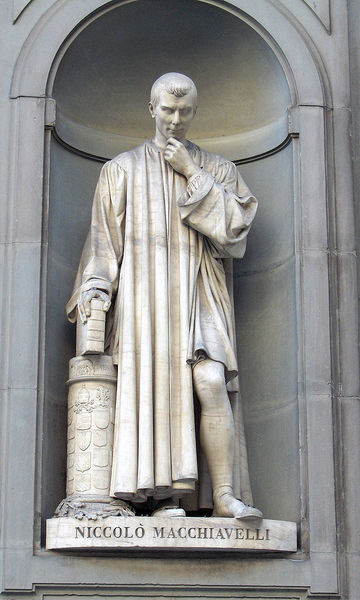
Machiavelli and 1984

After reading 1984 again I was struck by how similar many of the ways of control were similar to that recommend by Machiavelli. 

Now before the sarcastic responses come out about how this is obvious, after all Machiavelli liked tyrants, blah blah blah. 
NO this is actually somewhat surprising. While Machiavelli is somewhat infamous for his discussions of how a person should rule as a monarchy in his book The Prince he was diametrically opposed to tyrants. Even if you ignore his writings from his Discourses on Livy he did not support the uncontrolled use of power by an individual. And many of the advice he gives to monarchs on how to rule seems to be followed by the Party in 1984.

1. A Ruler should be feared but not hated: 
This was one of the most important aspects of ruling for Machiavelli was that the citizens should fear the ruler but not hated him. For Machiavelli he was adamant that the worse thing a ruler could be was hated. He should aspire to be feared and loved but must avoid at all costs being hated. So Machiavelli argues that a leader must at least appear to be moral, or act immoral in ways that will not bring hate to him.

And the Party exemplifies this. It fits all 3 parts of Machiavelli's advice. The Part makes itself both feared and loved by its members. (Fearing being arrested for thought crime and loving Big Brother for the protection he provides for them). Even the skeptical Winston, before being broke, expresses at times his love of Big Brother (like during the Hate) and his fear of him is always constant. 
And the hatred that the members of the party have is directed towards outsides forces, (Goldstein, the country they're at war with) instead of towards the Party.

2.  Another aspect Machiavelli argued is to avoid interfering with the common people as much as possible. If you need to do change he argues do it quickly and get it done with. And both of these aspects are again shown in 1984. The Party avoids interfering with the Proles as much as possible. They let them work but unlike how they treat the members of the Party they do not have the boot constantly at the neck of the Proles.(Or at least they do not seem to)  I think this is an important aspect of it because if they were to constantly and obviously oppress the Proles eventually the Proles would get fed up with it and might push back. But by not obviously oppressing them, and keeping them fed and entertained the Proles will be unlikely to ever rebel. 

3. Another aspect that reminds me of Machiavelli is part of his encouragement not to be hated. One part of it is it prevents people from being able to plot against you. Because if you try to convince another person to help you rebel and assassinate the leader that person has every reason to betray you. By doing so they will be rewarded and even if they do not they have every chance of not succeeding. And if you are not hated even if you succeed in your assassination attempt you will still be hated by the common people. So only a person who absolutely despises the ruler would agree to plot against the ruler. And this is remarkably similar to how the Party works except in this case the crime would not be plotting to overthrow the Party or assassinate Big Brother but simply not liking the Party.

While some aspects might not quite work with Machiavelli (and in the end he would not approve of the Party in 1984) I suspect that Orwell may have been influenced by Machiavelli.

Monday, February 11, 2013

"The First Time Any Man's Freedom is Trodden Upon, We're All Damaged"

After watching the clip we were shown in class (Spock's famous needs for the many speech) We were asked whether we side with the needs of the many or the needs of the few.
The clip and the question made me think of another Star Trek quote.

While usually we need to think of the needs of the many we have to remember that "the many" is nothing but individuals. To ask whether we support the needs of the many or the needs of the few puts them at odds against each other. And I don't feel like this is a necessity.

The Bill of Rights in America and similar laws elsewhere guarantee individual rights. But they do so for the betterment of society as a whole. Failing to protect individuals and (especially) minorities fails society as a whole. We recognize that sometimes that the majority can be wrong and we have to have certain rules. But these rules are always what we considered to be rights. Things that can not and should not be taken away without good reason, even under pressure from the majority. By respecting individuals we protect society as a whole.

While many utopia novels, (including some that will come up in the following months, 1984 for example) Focus on the betterment of the society at the cost of the individual. This misses the point that societies are individuals though. If the entire society is "surviving" but the people are not then the society is missing the point. This is the equivalent of putting a nearly dead human on life support.
In one way yes the society is still "alive" but it is not truly alive or responding. It does not have life as we know it. And as humans we recognize that survival is not the only important thing. The idea of living, however you define it, is more important that merely surviving.

Star Trek can shows use quite a lot. It forces to think about what is right and how both the many, and the few, must be accounted for in a society.

Monday, January 28, 2013

How Logic can improve the world


The plan that I believe would have the most wide reaching impact on the world is to encourage and emphasize logical thinking.
What: Logical thinking. This is the idea of understanding what logic thinking actually is (and includes things like knowing what fallacies are.) and what it is not. (Being emotionless, unable to make quick decisions etc...)  http://tvtropes.org/pmwiki/pmwiki.php/Main/StrawVulcan (note these are examples of ways people portray logic as being false. While many of the descriptors may be from movies and films which everyone knows aren't true they are still representative of mass culture and ideals.)

How: Simply by teaching it in the classroom as a requirement.
Why?: They are many reasons why logic is necessary

1. It improves people's ability to understand when someone is trying to manipulate them. Many groups, including everything from advertisements to politicians use fallacies in their attempts to convince people of a choice of action they support.  By making people understand what arguments are fallacies it would prevent them from being as easy to manipulate.

2. It can encourage people to act nicer. While it is unlikely that people will stop making decisions based purely on emotion by encouraging logical thinking it would make it difficult for someone to make a decision that isn't logical. And this is most important to prevent negative acts. Most positive acts can be argued logically (if you are improving someones life and it does not or has little damage to you that is a logical thing even if you were driven to do it by emotions.) However negative acts are much harder to argue logically (hurting someone for no reason or your own pleasure isn't logical. It just increases the odds that you will be hurt in response and could escalate dangerously). By encouraging logical thinking it might cause people to act more kindly.

3.  It would reduce the power of prejudice. If you act more based on logic and reasons it stands out when you are making judgement or treating someone negatively simply from personal dislike of certain characteristics of them.  Not that this will get rid of prejudice. But it will encourage people to be less likely to do negative acts out of prejudice, which is more important.

4. It improves scientific and mathematical education. Logic is a very scientific way to view the world. it has it's rules and structures and requires evidence to work properly. By encouraging and valuing this way of thinking it will lead more students becoming our next scientists and mathematicians  who have the best chance of dramatically changing the world perhaps into a Utopia. Science has had the greatest impact on mankind and has done amazing things for us.


Conclusion:
Logic isn't the only way to improve the world. Others have varied solutions. Many of these might very well be effective. But all will take use of part of this plan. All will be tested to see if they make sense. If they are consistent. If they are Logical. Logic is necessary for deciding an action by acting by pure random chance. And if pure chance could lead us to Utopia it most likely would've already done so.The best way to take an action that will have a positive impact on the world will be to use logical to determine what that action will be.

links:
http://www.startrek.com/legacy_media/images/200307/spock01/320x240.jpg
http://www.electrogent.com/wp-content/uploads/2012/08/argument_fallacies.jpg
http://sharkrobot.com/images/shirt_ninjabot_redteam.jpg